
Homeschool Parents' Common Mistakes When Choosing the Best Curriculum and Tutoring Support

Homeschooling continues to grow across America, with more families choosing to educate at home. This trend brings new opportunities and new challenges, especially for first-time parents who need homeschool support for curriculum, schedules, and learning goals.
Choosing a curriculum and finding the best homeschool help can feel overwhelming. Many parents make predictable mistakes during their first few years. These errors cost money, create stress, and sometimes discourage families from continuing.
Math Around the Corner has worked with many homeschool families in Fort Worth. We've seen what works and what doesn't. This guide helps you avoid common pitfalls when choosing curriculum and tutors.

Key Takeaways for Homeschool Success
- Start small with curriculum purchases. Buy only core subjects initially and add resources after understanding what works for your child.
- Match materials to your child's learning style. Visual, auditory, and kinesthetic learners need different approaches to succeed.
- Use tutors for challenging subjects. Getting homeschool support from professionals allows you to focus on areas where you teach best.
- Set realistic daily expectations. Many experienced homeschool educators recommend starting with shorter instruction sessions for younger children (about 45-60 minutes) and adjusting the schedule as needed. Older students usually complete core academics in about 3-5 hours, depending on the curriculum and pace.
- Address learning challenges early. Waiting to get help makes problems worse and intervention harder.
Understanding What Makes Homeschooling Different
Approximately 3.7 million students were homeschooled during the 2020-2021 school year, representing nearly 7 percent of the U.S. K-12 population, according to the National Home Education Research Institute. In the 2024-2025 school year, homeschooling grew at an average rate of 5.4 percent, nearly three times the pre-pandemic growth rate, according to Johns Hopkins University School of Education's Homeschool Hub.
Traditional schools follow a one-size-fits-all approach. Teachers manage 20 to 30 students at once, moving through material at a fixed pace. Curriculum choices happen at the district level, not by individual families.
Homeschooling works differently. Parents choose what, when, and how children learn. This flexibility creates amazing opportunities for personalized education. However, it also means parents must make dozens of decisions without the institutional support that traditional schools provide.
Many new homeschool parents try to recreate traditional school at home. They buy desks, set rigid schedules, and expect children to sit still for six hours. This rarely works well. Children who struggle in traditional classrooms often thrive when allowed to learn in ways that match their natural rhythms.
The key is understanding that homeschooling offers freedom. You don't need to copy what schools do. Instead, you can design an approach that fits your child's needs, your family's values, and your daily schedule.
Mistake 1: Buying Too Much Curriculum Before You Start
The biggest mistake new homeschool parents make involves purchasing curriculum. They attend conferences, browse online groups, and see beautiful materials. They buy complete packages for multiple subjects and several grade levels. Many of these resources never get used.
Parents feel overwhelmed by options. They worry about making wrong choices. So they buy everything that looks good, thinking more is better. They spend hundreds or thousands of dollars before teaching a single lesson.
The problem becomes clear quickly. That perfect-looking math program frustrates your child. The science curriculum requires supplies you don't have. The literature program feels too advanced. Now you've invested significant money in materials that don't work.
Children also respond differently to home learning than to classroom learning. A quiet child might need movement and hands-on activities at home. A social child might need more discussion and group work. You won't know what works until you try it.
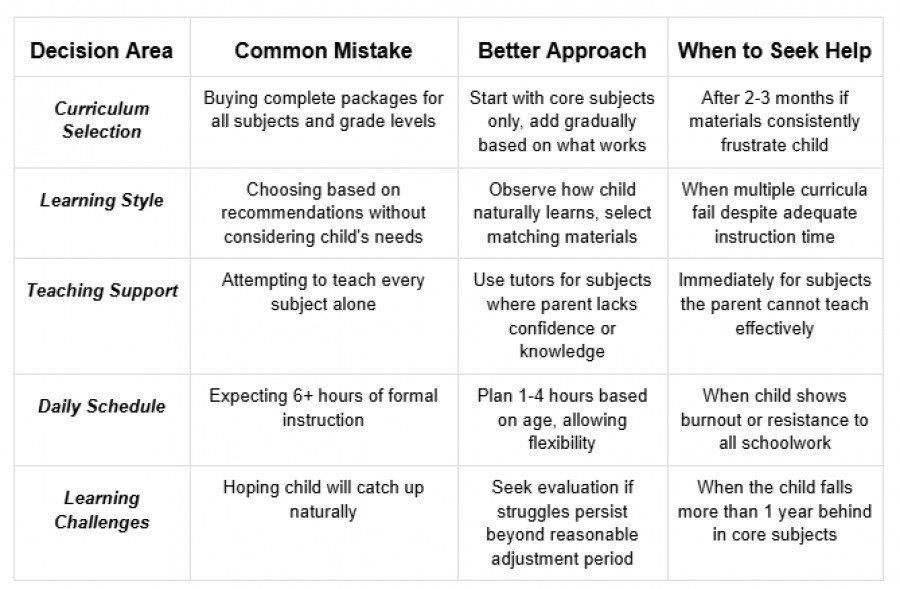
Better approach: Start with the basics for core subjects only. Use one math program, one reading/writing approach, and simple science activities. Spend a month or two learning how your child responds. Then add resources gradually as you understand what works.
Mistake 2: Ignoring Your Child's Learning Style
Parents often choose a curriculum based on recommendations without considering how their own child learns. A program that works beautifully for one student may frustrate another with different needs.
Many parents observe that children may have preferred ways of engaging with material, such as enjoying visual aids, discussion, or hands-on activities, but rigorous research does not consistently support rigid learning style categories. Instead, a balanced blend of approaches often benefits all learners.
Most children use a combination of styles, but one usually dominates. A visual learner forced to work through entirely audio-based lessons will struggle. A kinesthetic learner required to sit and read textbooks all day will resist.
Many curriculum companies advertise their programs as working for all learning styles. This rarely proves true. Most materials favor one approach. You need to identify your child's strengths and find resources that match.
Better approach: Observe how your child naturally explores new topics. Do they want to watch videos? Do they ask constant questions? Do they need to touch and build things? Look for a curriculum that emphasizes their preferred learning method. Supplement weak areas with support from tutors for homeschooling who can present material in multiple ways.
Mistake 3: Trying to Do Everything Alone
Homeschool parents often feel they must teach every subject themselves. They hesitate to ask for help or admit when something isn't working. This isolation leads to burnout and frustration.
No parent excels at every subject. Someone comfortable teaching reading might struggle with algebra. A parent who loves history might find science labs overwhelming. Trying to master and teach all subjects creates impossible pressure.
Children also benefit from learning from different people. A tutor brings fresh perspectives and teaching methods. Some students cooperate better with outside instructors than with parents. This doesn't mean you've failed as a homeschool parent. It means you're smart enough to use available resources.
Many homeschool parents also lack support networks. They don't connect with other homeschool families for activities, advice, or encouragement. This makes the journey feel lonely and harder than necessary.
Better approach: Identify subjects where you need homeschool support. Math tutoring proves particularly valuable for many families. Science tutors can handle complex topics and lab work. Foreign language tutors provide pronunciation and conversation practice that parents cannot always offer. At Math Around the Corner, we work with homeschool families to provide targeted tutoring of homeschool subjects while supporting the overall curriculum parents have chosen.
Mistake 4: Setting Unrealistic Expectations
First-time homeschool parents often have unrealistic ideas about how education at home works. They expect children to master material quickly, complete full days of formal instruction, or never experience difficulty.
Some parents swing the opposite direction. They avoid structure entirely, believing children will naturally learn everything they need. Both extremes create problems.
Young children have short attention spans. A kindergarten or first-grade homeschool day might last only 45 minutes to an hour for formal instruction. Many families find that attempting to replicate a traditional six-hour school day at home can be overly rigid and exhausting. Many homeschoolers adopt a more flexible rhythm that mixes focused lessons with experiential activities and independent work.
Older students need more time, but still don't require traditional school hours. Much of a school day involves transitions, crowd management, and non-instructional time. Efficient home instruction typically takes three to four hours for middle and high school students.
Parents also sometimes expect perfectly smooth days. They imagine peaceful learning sessions where children eagerly complete every assignment. Real homeschooling includes difficult days, resistance, and tears. This is normal, not a sign of failure.
Better approach: Set realistic daily goals based on your child's age and attention span. Plan core academics for morning hours when everyone has energy. Accept that some days will not go as planned. Flexibility is one of homeschooling's greatest strengths. Use it.
Mistake 5: Delaying Help for Learning Challenges
Some parents notice their children struggling with specific subjects but delay seeking help. They hope the child will catch up naturally. They try different curricula, thinking that materials are the problem. They avoid testing that might reveal learning disabilities.
This delay allows learning gaps to widen. A child who struggles with reading in second grade faces even bigger problems in fourth grade when all subjects require strong reading skills. A student who doesn't master basic math facts struggles with algebra later.
Professional tutoring and homeschool services can identify underlying issues. Dyslexia, ADHD, auditory processing disorders, and other challenges affect learning. Early intervention makes a huge difference. The longer families wait, the more difficult remediation becomes.
Parents sometimes feel embarrassed about needing help. They worry that using tutors means they're failing as homeschool parents. The opposite is true. Recognizing when professional support helps shows good judgment and commitment to your child's success.
Better approach: Monitor progress carefully in core subjects, especially reading and math. If your child consistently struggles despite appropriate materials and instruction, seek evaluation. Professional tutors can determine whether the problem stems from the curriculum, teaching approach, or an underlying learning challenge. The best homeschool help comes from catching problems early and addressing them directly.
How to Choose Tutors for Homeschooling
Not all tutoring works well for homeschool families. Traditional tutoring focuses on helping students keep up with classroom instruction. Homeschool tutoring must work differently because there is no classroom to track.
Look for tutors who understand homeschooling. They should ask about your curriculum and learning goals. They need flexibility with scheduling since homeschool families don't follow traditional school calendars. They should communicate clearly with you about progress and needs.
The best tutors for homeschoolers adapt to different teaching methods and materials. They work at the student's pace rather than pushing through predetermined lessons. They understand that homeschooled students might be ahead in some areas and behind in others compared to grade level.
At Math Around the Corner, we specialize in working with homeschool families. Our tutors review your current coursework and materials. We customize instruction to support what you're already teaching. Sessions happen at times that fit your schedule, including daytime hours when traditional students are in school.
Finding Balance in Your Homeschool Approach
Successful homeschooling balances structure with flexibility, independence with support, and academics with life learning. Parents who avoid the common mistakes above create sustainable approaches that work year after year.
Start small and build gradually. Don't buy everything at once. Give yourself and your children time to adjust to learning at home. Use resources like tutors for homeschooling when needed rather than trying to do everything alone.
Remember that every homeschool looks different. Your friend's perfect curriculum might frustrate your child. Your neighbor might need tutoring in subjects where your child excels. This is normal and expected. Homeschooling allows you to customize education for each child.
Decision-Making Framework for Homeschool Parents

Getting Started with Homeschool Support
If you're struggling with curriculum choices or need tutoring in homeschool subjects, Math Around the Corner can help. We've worked with Fort Worth homeschool families since 2006, providing personalized instruction that complements your chosen curriculum.
Our tutors offer support in mathematics, science, English, foreign languages, and social studies. We also provide SAT and ACT preparation for homeschooled students planning to attend college. Placement testing helps identify where your child needs support and where they excel.
Sessions are available at times that work for homeschool schedules. We offer both in-person instruction at our Fort Worth location and virtual tutoring for families outside the area. Our flexible approach recognizes that homeschool families structure their days differently from traditional schools.
Ready to find the best homeschool help for your family?
Call (817) 720-6284 or email scheduling@matharoundthecorner.com to discuss your needs and explore our homeschool support services. We'll help you avoid common mistakes and create an approach that works for your unique situation.