
How to Tell If Your Child Needs Algebra Tutoring in Fort Worth, TX

Most students who fall behind in algebra start showing warning signs in 6th or 7th grade, long before they take a formal algebra class. Catching those signs early and pairing your child with one-on-one algebra tutoring can change the entire direction of their math education.
This guide covers when algebra struggles typically begin, what common math mistakes to watch for, and how we approach tutoring algebra at Math Around the Corner with a hands-on, personalized method that can fix the problem before it becomes permanent. We believe every student deserves instruction built around their specific gaps, not a one-size-fits-all program that moves on before they are ready.
Key Takeaways
- Algebra struggles often start in late elementary or early middle school, not in Algebra I class.
- Avoiding homework, falling test grades, and math anxiety are the earliest warning signs.
- One-on-one tutoring works faster than group sessions because it targets your child’s specific gaps.
- Pre-algebra is the foundation; students who miss it tend to struggle through high school math.
- Starting tutoring algebra early, not just before finals, produces the best long-term results.
Why Do Students Struggle with Algebra in the First Place?
Algebra is hard for most students because it requires abstract thinking that younger brains are still developing.
In arithmetic, everything is concrete. You add numbers together and get an answer. In algebra, you work with unknowns, variables, expressions, and equations, and the rules change depending on context. That mental shift is genuinely difficult, especially without a strong number-sense foundation.
A large body of research points to a consistent pattern. According to the National Center for Education Statistics , only 26% of 8th graders in the U.S. score at or above the “proficient” level in mathematics. That means nearly three out of four middle schoolers are not where they need to be when algebra instruction begins.
When a student misses key concepts in grades 4 through 6 (things like fractions, ratios, negative numbers, and order of operations), those gaps compound fast. By the time they sit in an algebra class, they are already behind.
When Do Algebra Struggles Usually Begin?
Most students start showing signs of algebra difficulty between 5th and 7th grade, during the pre-algebra years.
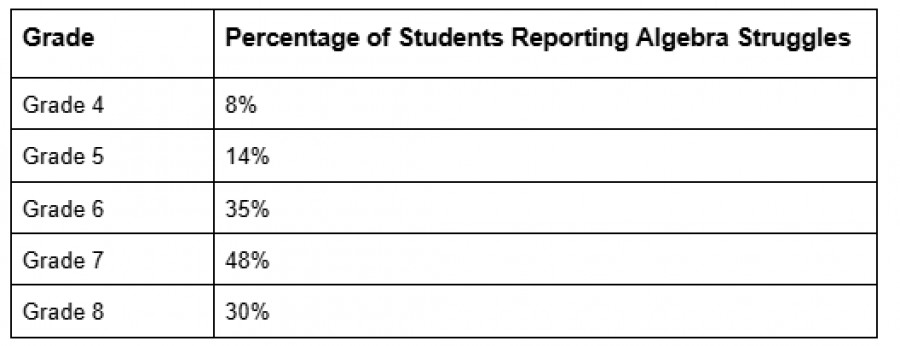
The table above shows when students typically report first struggling with pre-algebra or algebra concepts. The peak is 7th grade, which aligns with when most schools introduce a formal pre-algebra curriculum. But the trouble usually starts earlier and quietly.
Here is what that timeline often looks like:
Grades 4-5: Fractions and decimals start to feel confusing. Word problems take too long. The child begins avoiding math homework.
Grade 6: Ratios, proportions, and negative numbers are introduced. Grades start to slip. The student says, “I’m just not a math person.”
Grade 7: Pre-algebra begins. Variables and expressions feel abstract and frustrating. Test scores drop noticeably.
Grade 8-9: Algebra I arrives, and the student is already behind. Stress and avoidance become the dominant pattern.
If your child is anywhere in that window and battling common math mistakes, it is worth taking a closer look.
What Are the Early Warning Signs Your Child Needs Algebra Tutoring?
Watch for avoidance, confusion, and declining confidence, not just poor grades.
Poor grades are often the last sign, not the first. Here are the ones that show up earlier:
They avoid math homework or take much longer than they should. A child who used to finish homework in 20 minutes now sits at the table for an hour. That friction is often a signal that they are stuck on something foundational.
They say “I just don’t get it” without being able to say what specifically confuses them. This usually means the gap is in a concept that was taught weeks or months earlier; something they nodded along to but never actually understood.
They can do the steps but cannot explain why. Algebra requires understanding, not just memorizing procedures. A student who follows steps without understanding them will hit a wall as soon as the problem type changes.
Their test grades are inconsistent. They do fine on homework (where they can look up examples) but struggle on tests (where they have to retrieve and apply the concepts themselves).
They express a lot of anxiety around math tests or class participation. A University of Cambridge study found that 77% of children with high math anxiety are actually average to high achievers on curriculum tests, meaning anxiety, not ability, is what holds them back. This is not a personality trait; it is a response to not feeling prepared.
How Does One-on-One Algebra Tutoring Fix These Problems?
One-on-one tutoring identifies exactly where the gap is and works backward from there.
Group tutoring and classroom instruction move at the pace of the group. That works for students who are on track. For a student who missed a key concept two years ago, it does nothing.
Here is what personalized algebra tutoring actually looks like when done well:
The Tutor Finds the Real Starting Point
A good tutor does not start at chapter one of the algebra textbook. They start with a quick diagnostic, a conversation, and a few targeted problems to find out exactly where the student’s understanding breaks down. That might be fractions. It might be negative numbers. It might be the distributive property. Whatever it is, that is where the real work begins.
The Instruction Matches Your Child’s Learning Style
Some students need to see a concept drawn out visually. Others need to talk through the logic out loud. Others need to do ten practice problems before something clicks. A one-on-one tutor adjusts in real time. A classroom teacher with 25 students cannot.
Confidence Is Rebuilt Alongside Skill
Math anxiety does not go away on its own. It goes away when a student experiences consistent small wins - problems they can actually solve, concepts they genuinely understand. A tutor who is invested in the student as a person, not just as a grade, can create that environment.
This is exactly how Math Around the Corner approaches every student. Carol Bearden founded the company after watching a 6th grader go from failing to earning an A, not through pressure or drilling, but through genuine connection and targeted instruction. That same philosophy still drives every tutor on the team today.
What Does Learning Algebra Fast Actually Look Like?
Learning algebra fast is not about shortcuts; it is about removing the backlog of confusion as quickly as possible.
Students who work with a tutor consistently, once or twice a week, typically see meaningful improvement within 4 to 8 weeks when the tutoring is well-matched to their specific gaps. The key variables are:
- How far back do the gaps go
- How often does the student meet with their tutor
- Whether the student is doing the work between sessions
At Math Around the Corner, based on our internal tracking, 98% of students who attend weekly sessions with their assigned tutor pass with an A or B. That number holds because the tutors do not just help with tonight’s homework. They rebuild the foundational understanding that makes tomorrow’s homework possible.
What About Virtual Tutoring for Algebra?
Virtual algebra tutoring is just as effective as in-person tutoring when the relationship and instruction are strong.
For families in Dallas or across the DFW metroplex who cannot make it to the Fort Worth location, virtual tutoring sessions offer the same personalized, one-on-one experience online. The tutor can share screens, work through problems in real time, and maintain the same quality of relationship that makes in-person sessions work.
For busy families with packed after-school schedules, virtual sessions also remove the commute, which means your child shows up for tutoring without already being worn out.
Math Around the Corner offers virtual tutoring for students throughout the Dallas-Fort Worth area and nearby regions.
Private vs. Group Tutoring for Algebra: Which Works Better?
For students with specific gaps, private tutoring produces faster results than group sessions.
Group tutoring is useful for students who are mostly on track and just need reinforcement. But algebra is a subject where one misunderstood concept can block everything else. In a group setting, there is rarely time to stop and trace a student’s confusion back to its root.
In a private session, the tutor can spend 20 minutes on one concept if that is what the student needs. They can re-explain it three different ways. They can catch the moment the student’s face changes, the moment something finally clicks, and build from there.
That kind of responsiveness is what makes one-on-one algebra tutoring the right choice for students who are struggling.
Ready to Get Your Child Back on Track in Math?
If your child is avoiding math homework, losing confidence, or falling behind in pre-algebra or algebra, the right time to act is now, not after the next failed test.
Math Around the Corner serves students from Kindergarten through college, with one-on-one tutoring in math, science, and more. We are locally owned, hands-on, and open seven days a week to fit your schedule. Students in Fort Worth and across the DFW metroplex, including Dallas and nearby areas, can reach us for in-person or virtual sessions.
Call us at (817) 720-6284 or reach out at scheduling@matharoundthecorner.com to get started.
Math Around the Corner 6134 Southwest Blvd, Fort Worth, TX 76109
Hours: Mon-Fri 9 AM-10 PM | Sat 9 AM-5 PM | Sun 12 PM-8 PM