
How to Build a Study System Before Final Exams: Schedules, Spaced Repetition, and Active Recall

The students who perform best on final exams are not always the ones who study the most. They are the ones who study most effectively. That difference comes down to having a real system, not a last-minute pile of notes and a hope that something sticks.
Building strong student organization skills and exam strategies before finals season starts gives your child a serious advantage. It reduces stress, improves retention, and turns a chaotic two-week sprint into a manageable, confidence-building process.
At Math Around the Corner, we have spent nearly two decades helping Fort Worth students build exactly that kind of system, and the results speak for themselves.
Here is how to build that system, one step at a time.

Key Takeaways
- Strong student organization skills start with building your study system two to three weeks out, dramatically outperforming cramming the night before.
- Spaced repetition is one of the most effective academic success strategies available, producing measurably higher exam scores than massed review by reviewing material at increasing intervals.
- A subject-by-subject study schedule is a core exam preparation strategy that removes the guesswork and prevents important topics from falling through the cracks.
- Active recall (self-testing) is among the top exam strategies that beat passive re-reading for long-term retention every time.
- A tutor can help students identify exactly which gaps to close before the exam, saving time and overcoming test anxiety.
Why Most Students Study the Wrong Way
Most students study by re-reading their notes or the textbook. It feels productive. It is not.
Re-reading creates a false sense of familiarity. The material looks familiar because you have already seen it, not because you actually know it. When the exam question arrives in a different format, that surface-level recognition falls apart.
The academic success strategies that actually work are built around active engagement with material: retrieving it from memory, testing yourself, spacing your review sessions, and connecting concepts to one another.
The good news: these strategies are not complicated. They just need to be set up intentionally before the pressure of finals week hits.
What Is a Study System, Really?
A study system is not a highlighter color code or a pretty planner. A study system is a repeatable process that tells a student what to study, when to study it, and how to measure whether they actually know it.
It has three components:
A schedule that maps out every subject across the available weeks before exams. A method for reviewing material that goes beyond passive reading. And a way to track what has been learned versus what still needs work.
Without all three, students default to studying what feels comfortable, which usually means the subjects they already understand, and avoid the material that actually needs attention.
Step 1: Build Your Study Schedule First
Before opening a single textbook, sit down with a calendar.
Count the number of days until the first final exam. Then map each subject to specific study blocks, working backward from the exam date. This is the foundation of good student organization skills, getting ahead of the timeline instead of reacting to it.
A simple framework that works well for most students:
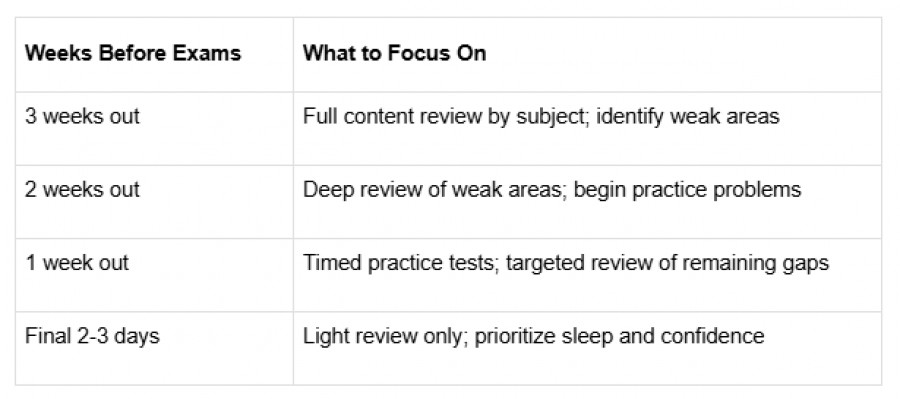
The key is distributing study time across subjects, not saving everything for the week before. Students who spread their review over three or more weeks retain significantly more than those who compress it into a single intense period.
Step 2: Use Spaced Repetition Instead of Cramming
Spaced repetition (SR) is the practice of reviewing material at increasing time intervals, reviewing a concept after one day, then three days, then a week, then two weeks. Each review session reinforces the memory trace before it fades completely.
The data on this is clear. University of Leicester research found that students who used spaced repetition scored an adjusted mean of 70% on exams, compared to 64% for those who crammed and 61% for students who used no structured review method at all.
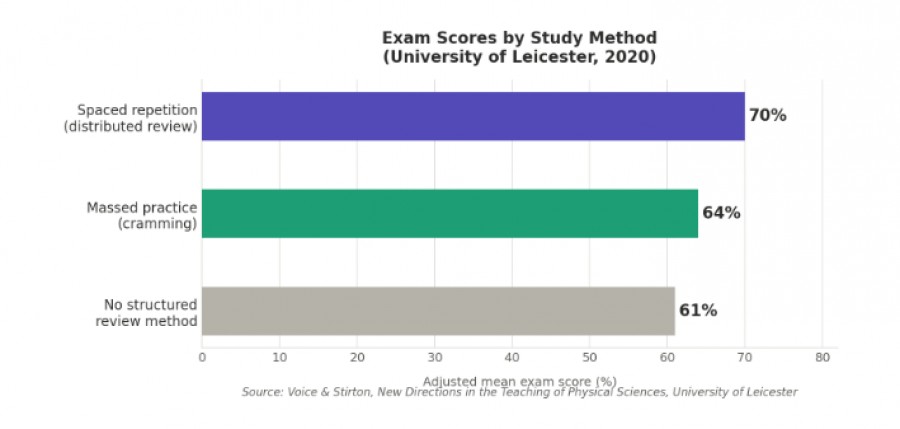
That 9-point gap between spaced repetition and no structured review represents real grade movement, often the difference between a B and an A, or a C and a B.
For younger students working on foundational math concepts, this approach is especially powerful. Reviewing multiplication or fraction operations in short sessions over several weeks locks in the understanding far better than a single long study session before a test.
Step 3: Replace Re-Reading with Active Recall
Once the schedule is in place and review sessions are spaced out, the next piece is changing how students review material.
Active recall means testing yourself on information rather than passively looking at it. Flashcards, practice problems, teaching a concept out loud to a parent, or simply closing a notebook and writing down everything you remember are all active recall methods.
Research published in PMC found that students using spaced repetition software scored 6.2 to 10.7% higher on standardized exams compared to those using traditional study methods.
The reason is straightforward: retrieving information from memory strengthens the neural pathways that connect you to that information later. Re-reading does not create those same pathways. It just refreshes visual recognition.
Practical active recall tools that work:
- Flashcards (physical or digital)
- Practice problems done without looking at notes first
- The "blank page" method: write everything you know about a topic from scratch
- Teaching the concept to someone else forces you to identify gaps in your own understanding
Step 4: Prioritize by What Is Actually on the Exam
Strong exam strategies are not just about how you study. They are about what you study. Students who treat all material equally run out of time before finals and end up underprepared on the topics that matter most.
Ask teachers directly: What format will the exam take? Which units are weighted most heavily? Will there be an essay component, free-response questions, or multiple-choice only?
That information shapes how study time should be allocated. A math final that is 60% algebra and 40% geometry should receive study time proportional to that breakdown, not split evenly because both are on the syllabus.
A tutor can be especially helpful here. Because tutors see exactly where a student makes mistakes on practice problems and assessments, they can identify the specific concepts that need the most attention before the exam, rather than having the student guess.
Step 5: Create a Low-Distraction Study Environment
The right system breaks down without the right environment. A student studying with a phone nearby, even face down, retains less than a student whose phone is in another room entirely.
Effective study blocks need three things: a fixed location, a defined length, and no competing digital distractions.
The Pomodoro Technique , which involves 25 minutes of focused work followed by a 5-minute break, is a reliable format that prevents burnout and maintains concentration across longer sessions. Two or three Pomodoro blocks per subject per session is a realistic daily target for most students.
Study location matters too. The same desk, the same chair, the same general time each day builds a conditioned response. The brain associates that environment with focus and transitions into study mode faster.
How a Tutor Fits Into a Study System
A study system handles the structure. A tutor handles the content gaps.
Students often do not know what they do not know. They may have been moving through class material at a pace that left foundational gaps, gaps that become clear on final exams when questions connect multiple concepts together.
A private tutor works through practice problems alongside the student, catches the specific errors that keep showing up, and explains concepts in the way that the student actually processes information. That kind of individual attention is not available in a classroom of 25 students.
At Math Around the Corner, our tutors work one-on-one with students from Kindergarten through college across math, science, English, and more. Sessions are available Monday through Friday until 10 PM, Saturday until 5 PM, and Sunday until 8 PM, flexible enough to fit into any pre-exam schedule. And because our founder, Carol Bearden, personally matches each student to the right tutor, your child is never a random assignment from a large chain.
For families in Fort Worth and nearby areas across the DFW metroplex, our hands-on, boutique approach makes a measurable difference when it counts most. We work with every student to build the student organization skills that turn good intentions into real academic results.
What Happens When Students Skip the System
Without a structured approach, finals season tends to go the same way every year. The first week of exams is manageable because the earlier tests cover recent material. By the second week, when cumulative exams hit, students realize they never actually retained what they studied in September.
That is not a motivation problem. It is a systems problem.
The solution is not to study harder in the final 48 hours. It is to study smarter across the three weeks leading up to finals. A schedule, active recall methods, spaced review sessions, and targeted tutoring support create a compounding effect. Each study session builds on the last, and by exam week, your child walks in prepared rather than panicked.
Build the Right Habits Now, Before Finals Arrive
Academic success strategies work best when they are habits, not emergency measures. The students who perform consistently well on exams are the students who treat every unit as preparation for the final, reviewing regularly, practicing actively, and asking for help when a concept does not click.
If your child is heading into finals season and needs help closing content gaps or building a study plan that actually works, Math Around the Corner is ready to help.
Call us today at (817) 720-6284 to schedule a session with one of our Fort Worth tutors. We are also reachable via email at scheduling@matharoundthecorner.com . We serve students across the DFW metroplex, with virtual options available for Dallas families and nearby areas.
Success in Every Subject.